

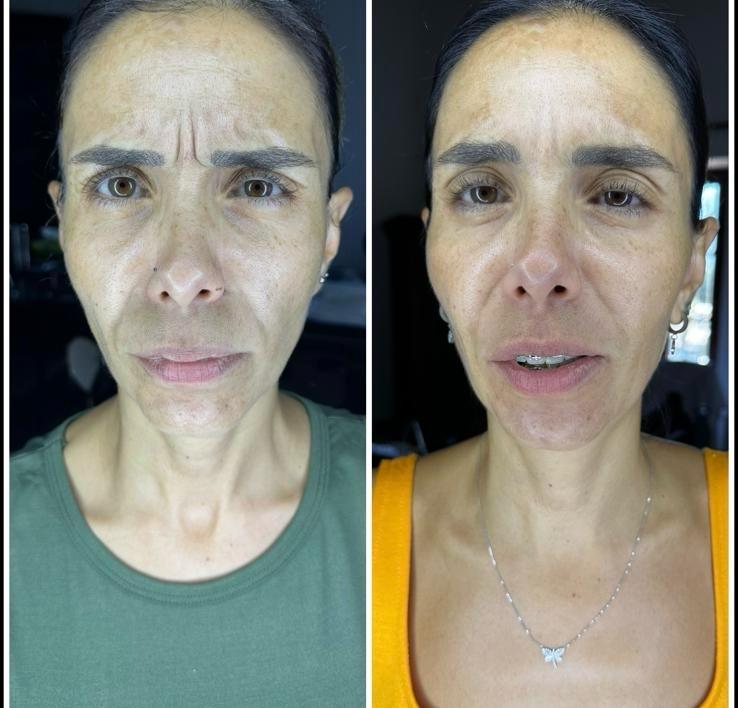
Neurotoxin is injected into the procerus and corrugator supercilii muscles to prevent vertical lines between the brows. These muscles are depressors of the eyebrows, and by injecting them, the muscular pull decreases, causing an elevation of the medial eyebrow and the disappearance of resistant vertical lines as the muscles remain relaxed and do not respond to frowning expressions.
This treatment is suitable for patients who frown constantly and for those who have deep lines even at rest. In some cases, Botox treatment alone is not sufficient to treat deep frown lines, and it may need to be combined with dermal filler treatment.
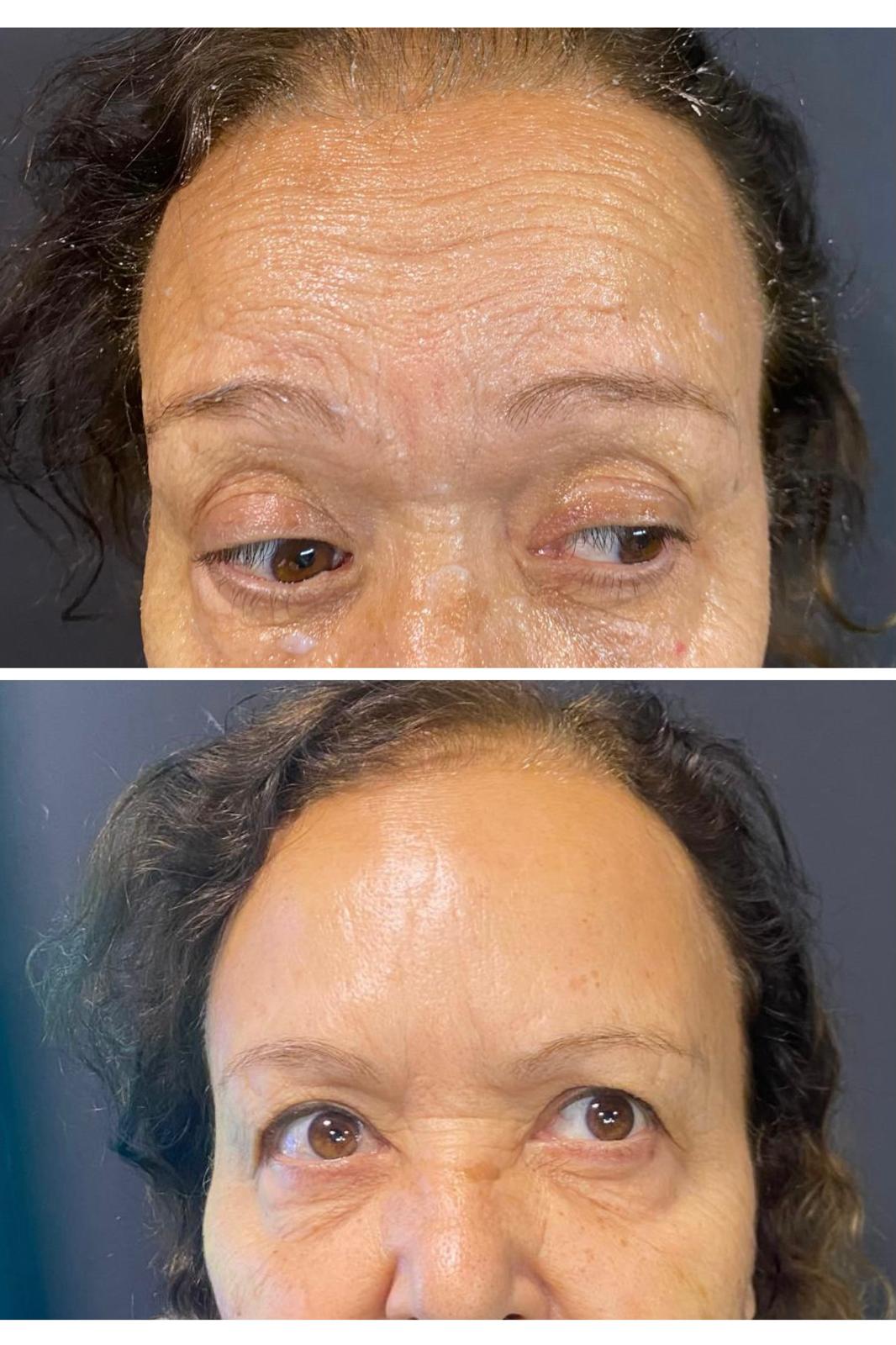
Transverse lines on the forehead that do not go away with Botox can be treated with dermal fillers containing hyaluronic acid. The contraction of the frontal muscle causes a brow lift, and patients usually don't realize how much they use this muscle until the transverse lines on the forehead appear. These lines deepen further as the patients continue to use the muscles constantly.
It is important to analyse patients before the injection, both in animation and at rest, to make correct adjustments of the neurotoxin required for the muscle to relax and to eliminate transverse wrinkles.
The adjustment of eyebrow raising is mostly according to the eyebrow shape in women, whereas in men, muscle relaxation and wrinkle clearance are mostly addressed. This treatment is not suitable for patients who have brow ptosis or a sagging eyelid. A sagging eyelid indicates that the frontalis muscle is too weak to support the skin and elevate the brow. Using neurotoxin in these cases will relax the muscle further, making it weaker and worsening the condition.
Treatments are dosed, adjusted, and positioned specifically for each patient, as muscle tone and pull are not the same in everyone. Some conditions, like bleeding disorders and neuromuscular diseases, are contraindications for Botox treatment. Therefore, these treatments should be administered by a medical professional.